

Interview - Paul Greenberg
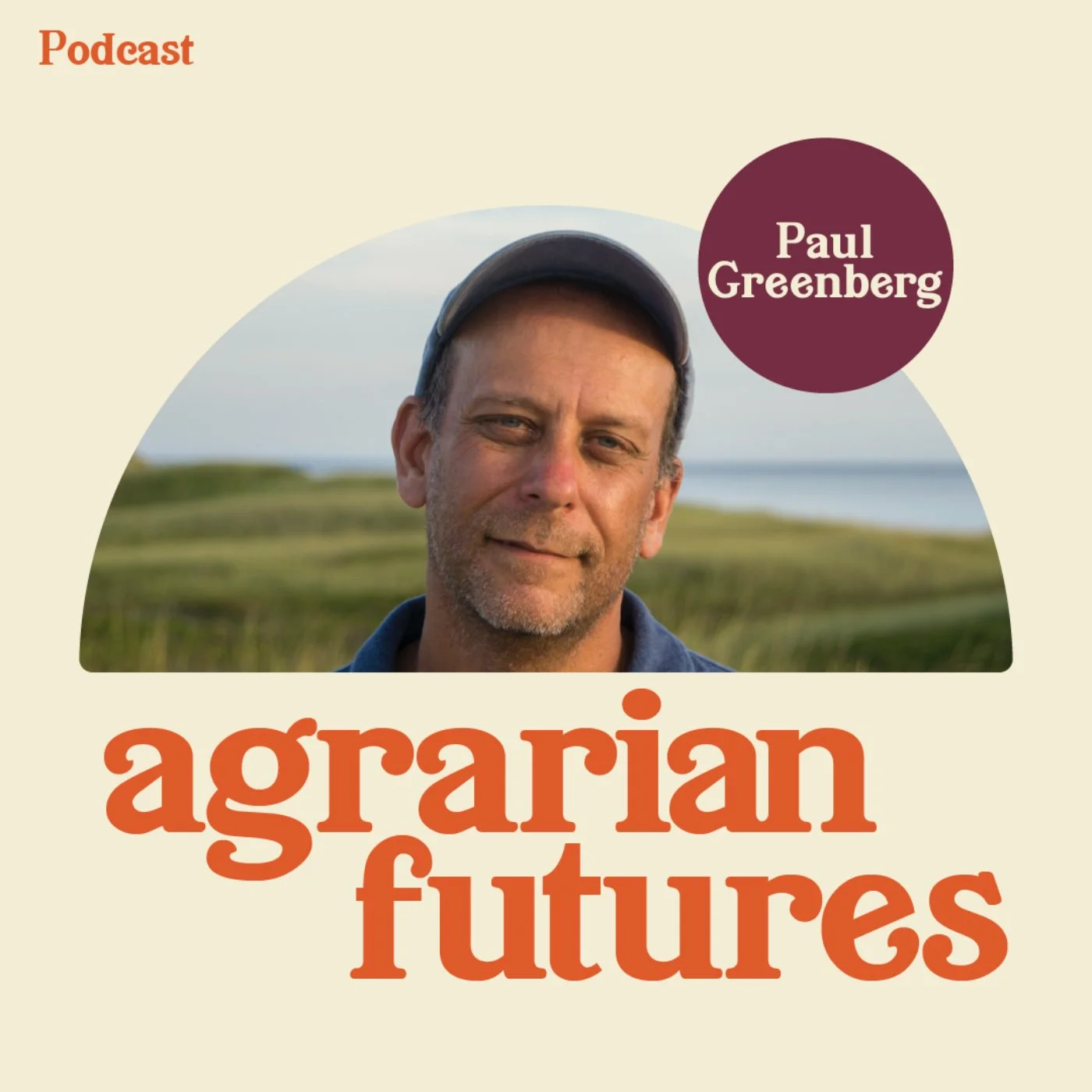
Fish have long been one of the last wild foods, a source of nourishment that connects us to the powerful ecology of the planet’s waters. But as journalist and author Paul Greenberg chronicles in his award-winning book Four Fish: The Future of the Last Wild Food, our relationship with the sea has dramatically changed over the past century. Once nearly all of the seafood we ate was wild; today, nearly half is farmed and the pressures on both wild and farmed systems are intensifying.
In this conversation, Paul doesn’t simply lament loss nor offer blind optimism. Instead, he helps us see where wild fisheries and aquaculture have faltered, where they remain strong, and how our choices today will shape the future of seafood and the oceans that feed us. Viewed through the lens of regenerative agriculture, his insights show that healthy waters and healthy land are part of the same story, and that ecological regeneration on farms must be paired with thoughtful stewardship of our rivers, estuaries, and oceans.
In this episode, we get into:
• What history teaches us about the human-ocean relationship and how it changed as we tamed the sea
• How modern fishing and seafood production mirror some of the same challenges in industrial agriculture
• Why some wild fisheries can still be models of careful management
• Where aquaculture offers real promise and where it deepens existing problems
• How ecological health, species diversity, and regional systems are essential for both land and sea
• What eating fish in ways that support long-term abundance actually looks like
• Why regenerative principles belong in discussions about oceans as much as soil
More about Paul:
Paul writes at the intersection of the environment and technology, seeking to help his readers find emotional and ecological balance with their planet. He is the author of seven books including the New York Times bestseller Four Fish: The Future of the Last Wild Food. His other books are The Climate Diet, Goodbye Phone, Hello World, The Omega Principle, American Catch, A Third Term and the novel, Leaving Katya.
Paul’s writing on oceans, climate change, health, technology, and the environment appears regularly in The New York Times and many other publications. He’s the recipient of a James Beard Award for Writing and Literature, a Pew Fellowship in Marine Conservation, a National Endowment for the Arts Literature Fellowship and many other grants and awards.
A frequent guest on national television and radio including Fresh Air with Terry Gross and the co-creator of the podcast Fish Talk, Paul also works in film, television and documentary. His PBS Frontline documentary The Fish on My Plate was among the most viewed Frontline films of the 2017 season and his TED Talk has reached over 1.5 million viewers to date. He has lectured widely at institutions around the world ranging from Harvard to Google to the United States Senate. A graduate in Russian Studies from Brown University, Paul speaks Russian and French. He currently teaches within New York University’s Animals Studies program and lives at Ground Zero in Manhattan where he maintains a family and a terrace garden and produces, to his knowledge, the only wine grown south of 14th Street.
Agrarian Futures is produced by Alexandre Miller, who also wrote our theme song. This episode was edited by Drew O’Doherty.