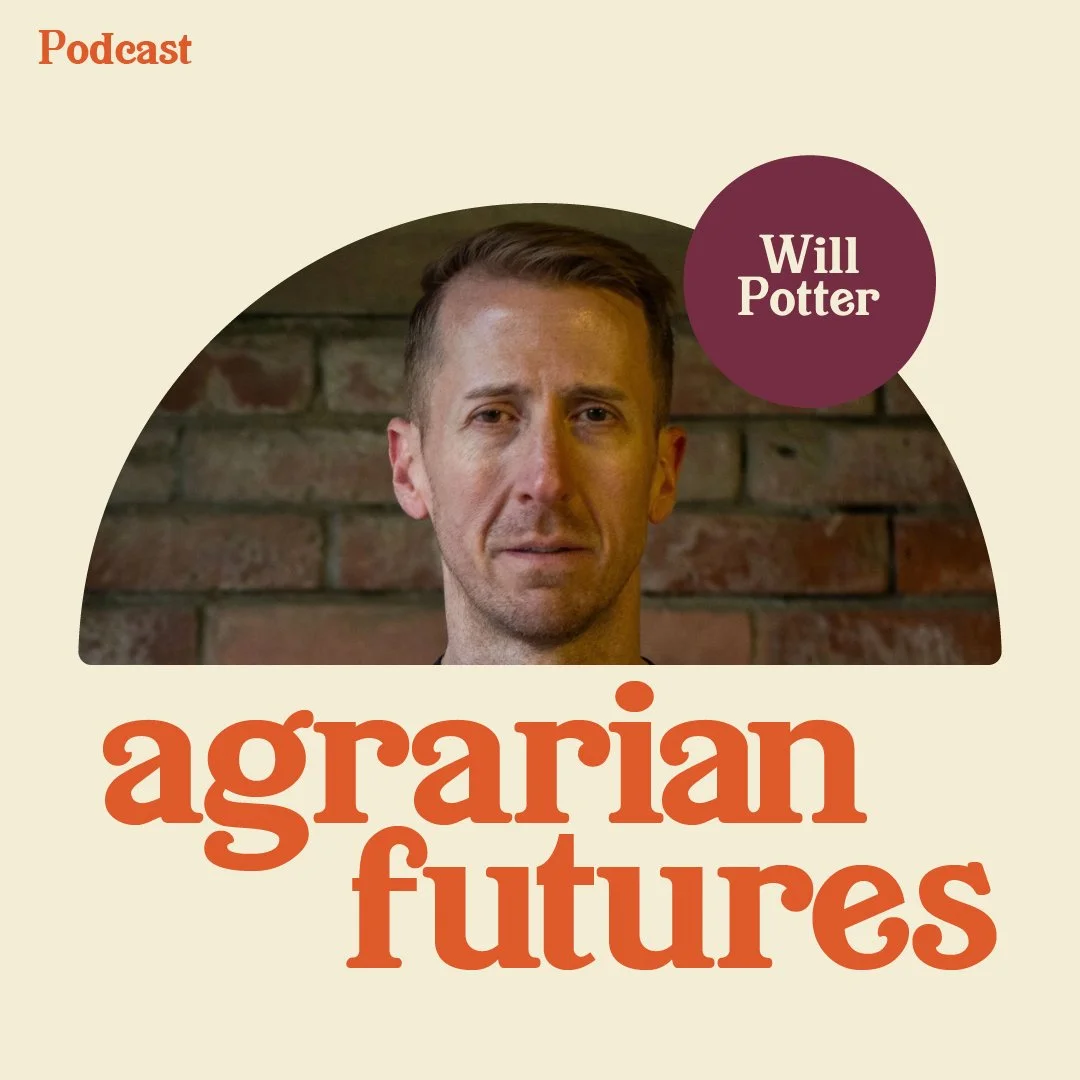
Interview - Will Potter
Our guest today Will Potter’s new book, Little Red Barns, started as a tale about censorship in journalism around industrial agriculture, but became something much bigger: a 10 year investigation look at how factory farming, an ages old mythos of family farms, and the rise of authoritarian politics have all worked in tandem to produce social, economic, and ecological disaster.
Will is an investigative journalist and author of Green Is the New Red. In this conversation, we talk about what he found writing Little Red Barns, from the industry's efforts to keep cameras out of factory farms to what that secrecy is really protecting.
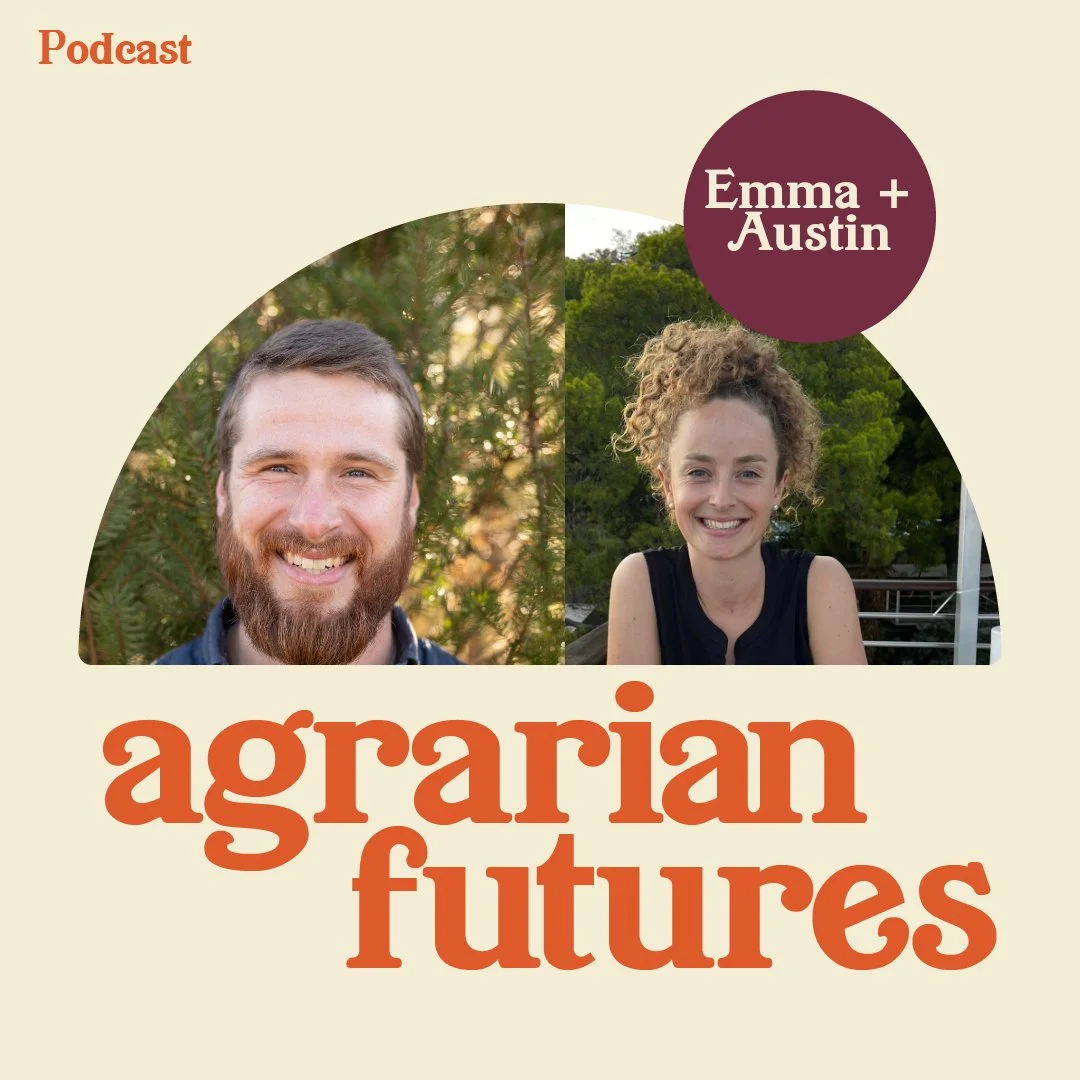
Conversation with Emma and Austin Part Two
Hi all! This time, we're doing something a bit different.
In this episode, Emma and Austin - hosts of Agrarian Futures - sit down to tell their own story, and share some of their key takeaways of 2.5 years of talking with brilliant farmers and thinkers about the future of our food system. Enjoy!
Conversation with Emma and Austin
Hi all! This time, we're doing something a bit different.
In this episode, Emma and Austin - hosts of Agrarian Futures - sit down to tell their own story, and share some of their key takeaways of 2.5 years of talking with brilliant farmers and thinkers about the future of our food system. Enjoy!
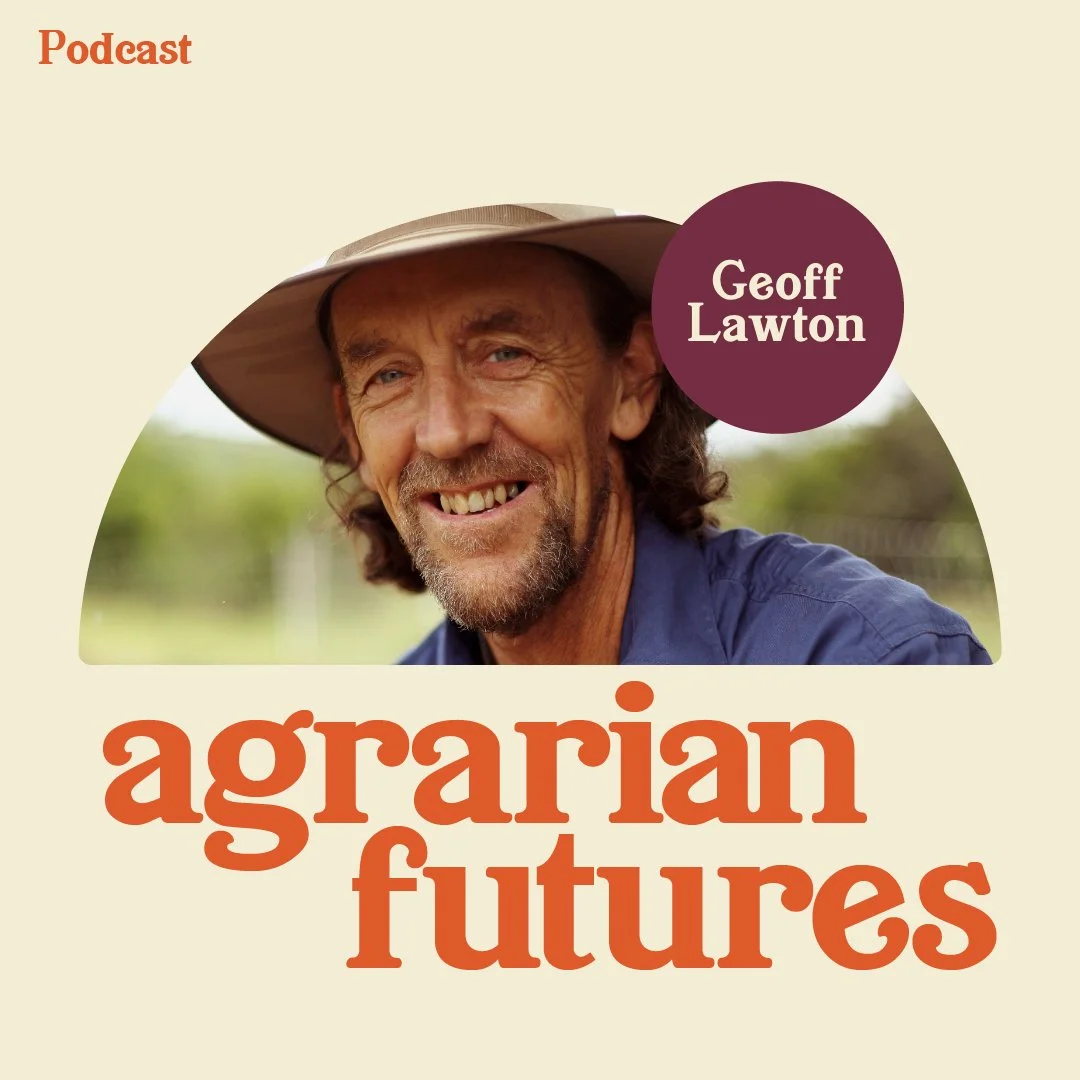
Interview - Geoff Lawton
In this conversation, Geoff Lawton offers us something rare: a genuinely hopeful and rigorously grounded vision of how humanity can become a reparative rather than destructive force on this planet.
As one of the world's leading permaculture designers and educators, Geoff has built demonstration sites and trained practitioners across six continents, from the Jordan Valley to the Australian bush. At Zaytuna Farm in New South Wales, he has spent over two decades transforming bare, degraded land into a thriving food forest with 32 bodies of water, hundreds of tree species, and a model for what regenerative living can look like at every scale.
Interview - Gabe Brown
Gabe Brown didn't set out to revolutionize agriculture. He set out to survive it.
After four consecutive years of crop disasters left him $1.5 million in debt, he had no choice but to question everything he'd been taught. What emerged from that reckoning became one of the most influential farms in the regenerative agriculture movement, and eventually two organizations working to spread those lessons globally: Understanding Ag, now consulting on over 37 million acres worldwide, and Regenified, a verification company built to cut through the greenwashing.
In this episode, we look forward. Where is regenerative agriculture headed? Who's driving it, and what's standing in the way?
Interview - Judith McGeary
You can't understand the modern food system without understanding the policy that shaped it. And you can't understand US food policy without understanding the Farm Bill.
Judith McGeary is an attorney, farmer, and the founder of Farm and Ranch Freedom Alliance, a national organization that supports independent family farmers and fights corporate consolidation of the food system. In this conversation, Judith breaks down what's actually in the Farm Bill, adds some needed nuance to the subsidy debate, and explains what's at stake as the bill moves through the US Senate right now - and how you - yes you! - can help shape it.
Interview - Fred Provenza
Our guest today, Fred Provenza, has spent his career listening to what animals can teach us: about landscapes, about food, about the deep intelligence woven into the living world.
Fred is professor emeritus of Behavioral Ecology at Utah State University, where he directed an award-winning research program that pioneered our understanding of how early experience, family, and landscape shape the foraging wisdom of animals. He is the author of over 300 scientific papers and three books, including Nourishment: What Animals Can Teach Us About Rediscovering Our Nutritional Wisdom, Foraging Behavior: Managing to Survive in a World of Change, and The Art & Science of Shepherding, co-authored with French herder Michel Meuret.
In this conversation, Fred draws on a lifetime of ranching, research, and wide-ranging inquiry, taking us from the pastures of Utah to the pre-alps of France. Together we reflect on what we've lost, what endures, and what it might mean to come home to a more intimate relationship with the land.
Interview - Judith Schwartz
Our guest today - Judith Schwartz - career showing us that the natural world is more resilient than we think, and that we have more power to restore it than we have been led to believe.
Judith is a journalist and author whose books, Cows Save the Planet, Water in Plain Sight, and The Reindeer Chronicles, have taken readers from the degraded hillsides of China's Loess Plateau to the Arctic tundra of Norway.
In this conversation, Judith shares stories from around the world of people healing land, rebuilding community, and rediscovering a sense of meaning in the process. It was lovely to sit with Judith and remember that restoration is closer than we think.
Interview - Glenn Elzinga
Many of us have lost the thread that connects us to our food. Glenn Elzinga is spending his life trying to pick it back up.
Glenn is the founder of Alderspring Ranch, a certified organic grass-fed beef operation in the remote Salmon River country of central Idaho. But describing it as a beef operation barely scratches the surface. Each summer, Glenn and his family, along with a rotating crew of interns, ride on horseback across 70 square miles of mountain range, living alongside their cattle for months at a time, following the melting snow and the greening grass. It is, as Glenn describes it, an ancient practice of shepherding that modern agriculture has all but forgotten.
In this conversation, Glenn challenges some of the deepest assumptions embedded in how we raise animals and grow food. What does it mean to be a caregiver rather than a caretaker? What happens when we let a cow be a cow? And what is lost when we reduce agriculture to a production equation?
Interview - Steve Gabriel
Steve Gabriel joins us to unpack one of the most consequential myths shaping how we grow food in America: the separation between forest and field.
As a co-steward of Wellspring Forest Farm in Mecklenburg, New York, author of Silvopasture, and researcher at the Cornell Small Farms Program, Steve has been listening. Through a SARE-funded project called Farming with Trees, he's been in conversation with over 120 farmers, from Bronx-raised beginners to multi-generational stewards, exploring not just how to plant trees, but why it matters and what gets in the way.
What he's found is that the barriers to agroforestry aren't just technical. They're cultural, historical, and deeply personal, rooted in a Eurocentric agricultural paradigm that told farmers to clear the land and never look back.
Interview - Jim + Mark Kleinschmit
Regenerative agriculture isn’t just about how we raise animals. It’s about whether the entire system around them makes sense.
Smaller, regenerative producers with meat businesses, have traditionally lacked an economic outlet for hides and other byproducts. That missing piece can be the difference between a system that works for regenerative farmers and one that doesn’t.
Mark and Jim Kleinschmit are working to rebuild that piece. Through Other Half Processing, they’re creating new pathways for regenerative hides and reconnecting ranchers to a leather economy that reflects the full value of the animal.
Interview - Author Benjamin Lorr
We walk into our local grocery store and most likely barely consider what’s on display in front of us. Forty thousand items. Stacked, uniform, produce. Cuisine from around the globe. Open often 24 hours.
As author Benjamin Lorr points out, that can be considered a miracle.
In The Secret Life of Groceries, Ben dives deep into the hidden machinery behind that miracle. He spent years inside the system, working behind a Whole Foods fish counter, riding cross-country with long-haul truckers, and tracing supply chains all the way to shrimp boats in Thailand. What he found is a system that delivers abundance, convenience, and quality at historically unprecedented levels. But it does so by squeezing every inefficiency out of the chain, and often squeezing workers and ecosystems along with it.
Interview - Author Elspeth Hay
I’m willing to bet that most of our listeners - like us - have traditionally seen acorns as food for squirrels, not people. But as Elspeth Hay points out in this conversation, that assumption says more about our food system than it does about the acorn.
For much of human history, acorns were a staple. They fed communities across North America, Europe, North Africa, and Asia - and in some cases - still do. They were managed, processed, stored, and celebrated. So how did we go from acorns as everyday food to acorns as woodland debris? In her fantastic book Feed Us with Trees, Elspeth traces how enclosure, industrial agriculture, and a narrow definition of “real farming” pushed perennial forest foods to the margins of our imagination.
Interview - Cate Havstad of Range Revolution
We’ve spent a lot of time on this show digging into the dire state of modern farming and ranching, and the challenging economics for those trying to build a regenerative future. Our guest today, Cate Havstad, is no stranger to these challenges as a firsthand as a first-generation farmer and rancher. That experience led directly to an innovative solution that could be an important missing piece in this economic puzzle.
As she explains, only about 65 percent of the cattle she sent out to slaughter was actually used, leaving hides and other materials treated as low-value byproducts rather than essential parts of a living system. That waste isn’t just ecological. It’s economic, and it puts real pressure on ranchers trying to do things the right way.
Cate is changing that. As the founder of Range Revolution, she’s building a new market for regenerative hides, turning them into high-quality leather goods while creating an additional revenue stream for ranchers committed to land stewardship. Her work challenges the idea that sustainability and luxury are incompatible, and shows how value-added products can help make regenerative ranching financially viable.
Interview - Joel Salatin
Joel Salatin is one of the most influential voices in the modern regenerative farming movement. As the founder of Polyface Farm in Virginia, he’s become known for building a radically different model of agriculture, one rooted in ecological systems, local markets, and a refusal to accept industrial “efficiency” as the end goal.
In this episode, Joel shares what he’s learned from decades of farming and advocacy, why the middle of the food system is where so many good farms get stuck, and what it will take to make regenerative agriculture a real alternative instead of a niche.
Interview - Paul Greenberg
Fish have long been one of the last wild foods, a source of nourishment that connects us to the powerful ecology of the planet’s waters. But as journalist and author Paul Greenberg chronicles in his award-winning book Four Fish: The Future of the Last Wild Food, our relationship with the sea has dramatically changed over the past century. Once nearly all of the seafood we ate was wild; today, nearly half is farmed and the pressures on both wild and farmed systems are intensifying.
In this conversation, Paul doesn’t simply lament loss nor offer blind optimism. Instead, he helps us see where wild fisheries and aquaculture have faltered, where they remain strong, and how our choices today will shape the future of seafood and the oceans that feed us. Viewed through the lens of regenerative agriculture, his insights show that healthy waters and healthy land are part of the same story, and that ecological regeneration on farms must be paired with thoughtful stewardship of our rivers, estuaries, and oceans.
Interview - Bob Quinn
If you want to understand what it takes to build a healthier local food system and bring rural communities back to life, you talk to someone who’s actually done it. Bob Quinn has spent decades farming in Montana, rebuilding soil, creating local markets, and pushing back against the idea that small towns and small farms are destined to disappear.
Through his farm and the Quinn Institute, Bob is exploring what a healthier rural economy - and a healthier food system - could look like. That includes everything from improving soil health and growing better food to rethinking how we organize our communities, our businesses, and even our underlying values.

Interview - David Montgomery
If regenerative agriculture is about rebuilding the foundations of our food system, then soil is where that story starts.
Geologist and author David Montgomery has spent decades tracing how the health of our soil shapes everything else: the nutrition in our food, the resilience of our farms, and the long-term fate of entire civilizations. What he shows is both sobering and energizing. We have degraded our soils at an astonishing pace, yet we now understand enough about how they actually work to turn the tide.
In this conversation, David helps us zoom out. He connects the collapse of ancient societies to the vulnerabilities we see in modern industrial agriculture, and he lays out what farmers around the world are doing to rebuild soil faster than it erodes. If regeneration is the goal, soil biology is the map.

Interview - Terence Courtney
Across the south, generations of black farmers and business owners have faced losing not just their land, but their livelihoods - pushed out by discriminatory lending, land theft, and the consolidation of power. Yet from that struggle has grown something powerful: a movement rooted in cooperation, where farmers pool their resources, share their knowledge, and build wealth together instead of competing for survival.
That spirit of collective power is what drives the Federation of Southern Cooperatives, where Terence Courtney works to support Black-owned farms and rural businesses through education, advocacy, and cooperative enterprise. The Federation’s model flips the extractive script of traditional capitalism, proving that shared ownership and community investment are sound economic strategies.

Interview - Beth Hoffman
What happens when you leave behind a career in food journalism to take over a family farm in Iowa? For Beth Hoffman, it meant putting theory into practice - and learning firsthand just how difficult it is to make small and mid-sized farming work in today’s economy.
In her book Bet the Farm and in her daily life raising grass-finished cattle and organic crops, Beth confronts the financial and cultural realities most farmers face: land that’s too expensive for beginners, markets that reward consolidation over stewardship, and infrastructure built for scale instead of community. Yet her story is also one of possibility - of finding ways to align values with viability and imagining what a more just and sustainable food system could look like.